
Blog
What Makes a USPAP-Compliant Woodworking Equipment Appraisal for Lenders and Courts
A USPAP-compliant woodworking equipment appraisal follows a defined scope of work, documented methodology, and a retained workfile, which is exactly what SBA lenders and courts require and an informal shop estimate cannot provide. This guide breaks down the standards, point by point, so you know what to ask for before you need one.
When a CNC router, a panel saw, or a wide belt sander sits on a loan collateral schedule or shows up as a disputed asset in a divorce or bankruptcy filing, the number attached to it has to survive scrutiny. That's the difference between a USPAP-compliant woodworking equipment appraisal and a dealer's quick opinion of value scribbled on a quote sheet. Our woodworking equipment appraisal service is built around the two USPAP standards that govern machinery and equipment work, and this article walks through exactly what those standards require, why SBA lenders insist on them, and why courts treat them as the practical baseline for surviving a reliability challenge.
What Does USPAP-Compliant Actually Mean for Equipment?
USPAP-compliant means the appraisal was developed and reported under the two standards published by The Appraisal Foundation that govern personal property and machinery valuation: Standard 7 (development) and Standard 8 (reporting). These aren't stylistic preferences. They're the difference between an opinion built on a documented process and an opinion built on someone's gut feel about what a used moulder is worth.
Standard 7 governs how the appraiser develops the value opinion. Before touching a single machine, a compliant appraisal requires the appraiser to:
- Identify the problem. What is being appraised (a CNC router, a full edgebander line, an entire dust collection system), the client, the intended use, and the type of value needed.
- Determine the scope of work. How much research, inspection, and analysis is necessary to produce a credible result given the intended use. A loan collateral appraisal on a $400,000 wide belt sander and panel saw line requires more depth than a quick opinion for internal planning.
- Apply the appropriate approach. For woodworking machinery this is almost always the cost approach (replacement cost new less depreciation) supported by market data on comparable used equipment sales, since active secondary markets exist for most shop machinery.
Standard 8 governs the report itself. A compliant report states the intended use and intended users, defines the type of value being concluded (fair market value, orderly liquidation value, forced liquidation value), sets an effective date, describes the scope of work performed, reconciles the analysis into a final conclusion, and includes a signed certification. The appraiser also retains a workfile: inspection notes, photographs, comparable sales data, and calculations that support the number in the report.
What an Informal Estimate Skips
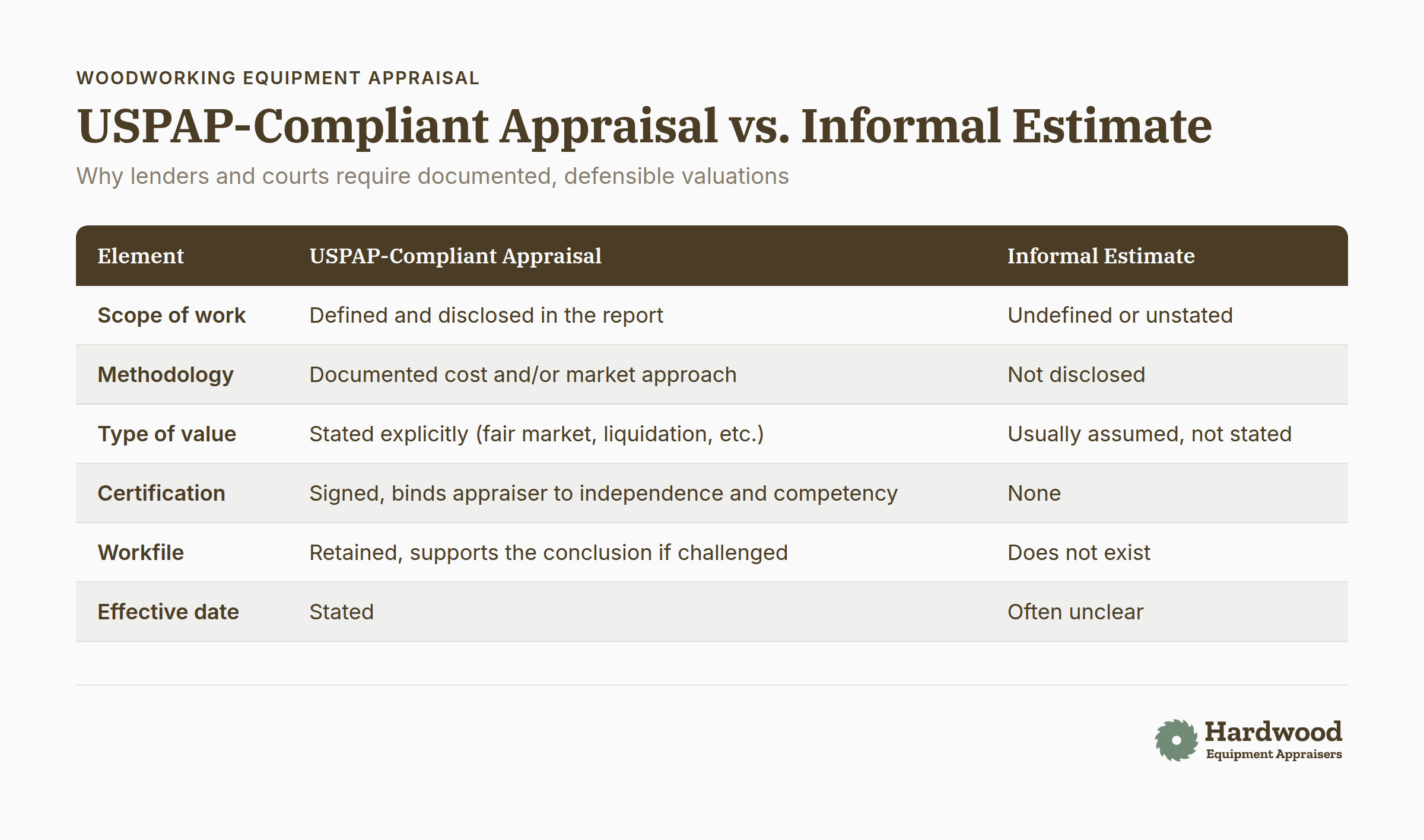
An informal estimate, whether from a dealer, a broker, or a shop owner's own research, typically skips every one of those steps. There's no defined scope of work, so nobody can say whether the number reflects a five-minute walkthrough or a thorough inspection. There's no documented methodology, so the number can't be checked or reproduced. There's no certification binding anyone to independence or competency, and there's no workfile, so if the number is ever questioned, there's nothing behind it.
| Element | USPAP-Compliant Appraisal | Informal Estimate |
|---|---|---|
| Scope of work | Defined and disclosed in the report | Undefined or unstated |
| Methodology | Documented cost and/or market approach | Not disclosed |
| Type of value | Stated explicitly (fair market, liquidation, etc.) | Usually assumed, not stated |
| Certification | Signed, binds appraiser to independence and competency | None |
| Workfile | Retained, supports the conclusion if challenged | Does not exist |
| Effective date | Stated | Often unclear |
Why SBA Lenders Require USPAP-Compliant Woodworking Equipment Appraisals
SBA lenders require an independent, written appraisal because the equipment is the collateral securing the loan, and the lender has no way to verify a borrower's or a dealer's claimed value without one. The appraiser has to be independent of the transaction: not the seller, not the borrower's business partner, and not someone with a financial stake in the loan closing. That independence is exactly what USPAP's certification requirement is designed to document.
Lenders generally expect an on-site inspection rather than a desk review based on photos or a spec sheet, because condition, hour meters, tooling completeness, and maintenance history all affect the value of a CNC router or a moulder line in ways a photo can't capture. The appraisal also needs to be dated appropriately close to the loan application; a valuation from 18 months ago doesn't reflect current market conditions for used woodworking machinery, which can shift meaningfully as commercial construction and cabinetry demand moves.
Collateral appraisals also need to distinguish new equipment value from used equipment value with real precision. A used panel saw purchased at auction and a new one still under manufacturer warranty are not interchangeable collateral, even if they perform the same function on the shop floor. Our guide on how to calculate the value of used equipment walks through the depreciation and market-comparison work that goes into that distinction. Appraisers working in this space typically hold credentials through organizations such as the American Society of Appraisers, the International Society of Appraisers, or the Certified Appraisers Guild of America, which is worth confirming before a lender accepts a report.
Engagements for machinery and equipment appraisals are quoted as a fixed fee after we scope the assignment (the number of machines, the complexity of the shop, and whether the intended use requires an IRS-qualified level of detail), never billed hourly.
Why Courts Require USPAP-Compliant Reports in Divorce, Bankruptcy, and Litigation
Courts favor USPAP-compliant appraisals because expert testimony has to meet a reliability standard, and a documented scope of work and workfile are what let an expert survive cross-examination. Federal Rule of Evidence 702 and the Daubert line of cases ask whether an expert's opinion rests on sufficient data and reliable methods, reliably applied to the facts of the case. USPAP compliance is not a literal statutory requirement in any of these proceedings, but it is the practical standard that most valuation experts rely on precisely because it forces the documentation a Daubert challenge is looking for.
In a divorce involving a family-owned cabinet shop, the equipment schedule (a full production line of panel saws, edgebanders, and a wide belt sander, say) often becomes a contested asset. In a bankruptcy proceeding, a trustee needs a defensible liquidation value for the same kind of equipment to determine what creditors can recover. In equipment litigation, whether over a damaged CNC router or a disputed sale, opposing counsel will look for exactly the gaps an informal estimate leaves open: no stated scope of work, no disclosed methodology, no workfile to produce in discovery.
Our estate valuation guide for woodworking equipment covers a closely related scenario: how appraisers document machinery values when an estate, rather than a court case, is the intended use. The underlying discipline is the same. A retained workfile lets an appraiser reconstruct and defend, months or years later, exactly how they arrived at a conclusion, including the comparable sales they relied on and the condition notes from the on-site inspection.
Key takeaway: the workfile is not paperwork for its own sake. It's the record that lets an appraisal survive being questioned under oath.
Why Insurers Want USPAP-Compliant Value Opinions for Shop Equipment Claims
Insurers want a documented, defensible value opinion because a claim payout on a destroyed dust collection system or a fire-damaged moulder needs to hold up if the claim is disputed or audited. A USPAP-compliant report gives the adjuster a stated type of value, a clear scope of work, and a methodology they can check against their own file, rather than a number with no explanation behind it.
This doesn't mean a USPAP-compliant appraisal guarantees a particular claim outcome or that an insurer will accept any given figure. It means the report is built to the standard insurers generally look for when they're deciding how much weight to give an outside valuation, which puts the policyholder in a stronger position during negotiation than a one-page dealer estimate would.
Getting a Defensible Appraisal Before You Need One
The pattern across lending, litigation, and insurance is the same: a USPAP-compliant woodworking equipment appraisal documents its scope of work, its methodology, and its supporting data well enough that someone outside the process, a lender's underwriter, a judge, an insurance adjuster, can follow the reasoning from inspection to conclusion. An informal estimate simply can't do that, no matter how experienced the person writing it is.
If you're financing a shop, working through a divorce or bankruptcy involving equipment, or documenting a claim, get the appraisal scoped and dated before you need to rely on it. Our team prepares USPAP-compliant reports for CNC routers, panel saws, edgebanders, wide belt sanders, moulders, and dust collection systems, and we're glad to talk through what your lender, court, or insurer specifically requires before the engagement begins.
This article is provided for general informational purposes only and does not constitute legal, tax, or financial advice. Readers should consult a qualified attorney or CPA regarding their specific circumstances.