
Blog
Replacement Cost vs. Fair Market Value: Why Your Woodworking Machine Gets Two Numbers
The same CNC router or wide-belt sander can carry two very different appraised values depending on whether you need replacement cost for insurance or fair market value for tax, estate, or resale purposes. This guide walks through both standards, the three valuation approaches behind them, and a worked example with real dollar figures.
A ten-year-old wide-belt sander can show up in one report at $58,000 and in another at $19,500. Neither number is wrong. They answer different questions. An insurance carrier wants to know what it costs to put an equivalent new machine on the shop floor today. The IRS, a divorce court, or a buyer wants to know what that specific used machine would actually sell for. Getting this distinction backward is one of the most common (and costly) mistakes shop owners make when they order a woodworking equipment appraisal for the wrong purpose.
Why the Standard of Value Drives the Number
Every appraisal is built around a defined standard of value, and that standard, not the machine's condition, is what produces two different dollar figures for the same asset. Our woodworking equipment appraisal team is asked constantly why a $240,000 replacement cost estimate and a $95,000 fair market value estimate can both be correct for the same CNC router. The answer is that they are not measuring the same thing.
Replacement cost answers: what would it cost to acquire a new machine with equivalent utility right now? Fair market value answers: what would this particular used machine, with its actual age, wear, and market position, bring in an arm's-length sale? A report has to state which question it is answering, along with the effective date and the assumptions behind it, before its number means anything.
Because the fee for an appraisal is quoted as a fixed amount after we scope the assignment, the intended use matters just as much as the machine itself. A standard report and an IRS-qualified report for machinery and equipment are priced differently precisely because the intended use, not the machine's value, determines how much documentation and analysis the assignment requires.
What Fair Market Value Means for a Woodworking Machine
Fair market value is the price a specific used machine would bring between a willing buyer and a willing seller, with neither party under compulsion to act and both having reasonable knowledge of the relevant facts. That willing-buyer, willing-seller standard is the one the IRS applies to charitable donations, and it is outlined in IRS Publication 561, which also confirms that a qualified appraisal is generally required once a claimed noncash deduction exceeds $5,000.
That same standard, not a forced-sale or liquidation premise, governs estate and gift valuations, divorce equitable-distribution matters, and most resale analysis. If you are donating a moulder to a trade school, settling an estate, or dividing shop assets in a divorce, the appraiser is answering "what would this used machine actually sell for," not "what would a new one cost." Donors preparing Form 8283 for a woodworking equipment donation need this exact standard, and an appraiser who defaults to replacement cost figures for that purpose is building a report that will not hold up.
An Investopedia overview of IRS Publication 561 notes that cost or selling price, comparable sales, and expert opinion all factor into a defensible fair market value conclusion, but replacement cost alone is never treated as a substitute for market evidence.
What Replacement Cost Means for an Insurance Appraisal
Replacement cost new is what it would cost today to buy a new machine of equivalent capacity and function, including freight and installation, without any reduction for depreciation. Insurance policies typically define coverage around either replacement cost value (the full cost to replace) or actual cash value (replacement cost minus depreciation), and which one applies changes the payout dramatically after a fire, flood, or theft claim.
Most equipment insurance appraisals lean on replacement cost new less depreciation, sometimes shortened to RCNLD, because the policy needs a defensible number for both the coverage limit and the eventual claim settlement. The International Society of Appraisers distinguishes fair market value from replacement cost on exactly this basis: replacement cost only becomes relevant to a fair market value conclusion when there is a reasonable, demonstrated connection between the two, which is rarely a one-to-one relationship for older machinery.
Watch out: A shop that insures its equipment using a fair market value figure instead of replacement cost often ends up underinsured. If a $240,000 CNC router is destroyed and the policy was written against a $95,000 fair market value estimate, the payout will not come close to covering a new machine.
Three Approaches Appraisers Use to Reach These Numbers
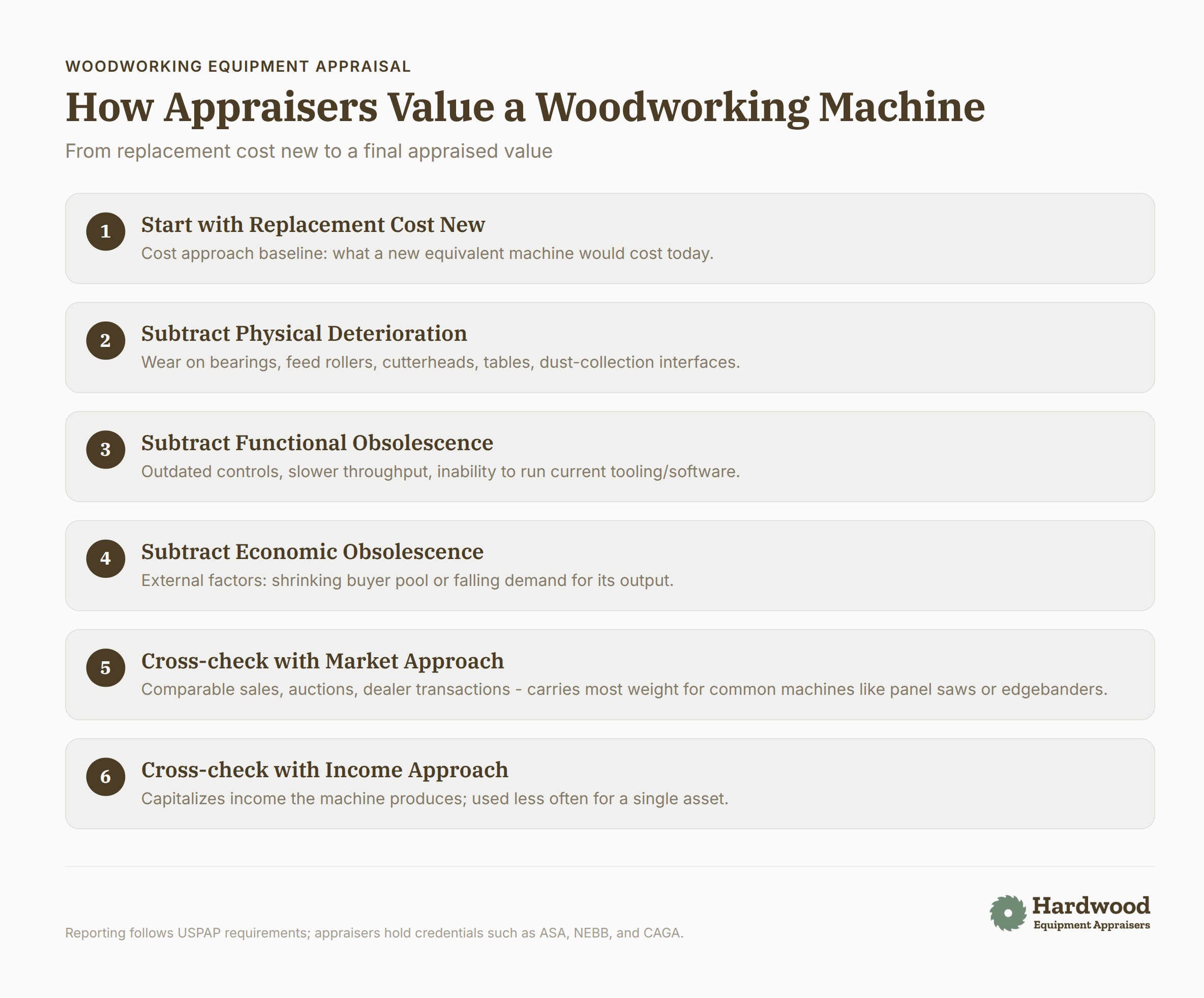
Machinery and equipment appraisers generally work from three recognized approaches, and which one carries the most weight depends on the standard of value being sought. The cost approach starts from replacement cost new and subtracts physical deterioration, functional obsolescence, and economic obsolescence to arrive at a depreciated value. The market approach relies on comparable sales, auction results, and dealer transactions for similar equipment. The income approach, used less often for a single machine, capitalizes the income that asset produces.
Industry guidance on machinery and equipment valuation treats these three approaches as the standard framework regardless of asset type. For a woodworking machine specifically:
- Physical deterioration covers wear on bearings, feed rollers, cutterheads, tables, and dust-collection interfaces from years of production use.
- Functional obsolescence covers outdated control systems, slower throughput, or the inability to run current tooling and software compared to a new equivalent.
- Economic obsolescence covers external factors like a shrinking pool of buyers for a particular machine type or reduced demand for the products it produces.
For a common, actively-traded machine like a panel saw or edgebander, the market approach usually carries the appraisal because comparable sales exist. For a highly specialized or recently released CNC platform with few trade comparables, the cost approach carries more weight because reliable market data is thin. Our appraisers hold credentials with organizations such as the ASA, NEBB, and CAGA, and every machinery and equipment appraisal we prepare states which approach or combination of approaches was used and why, in line with USPAP reporting requirements.
Worked Example: A Used Wide-Belt Sander Valued Two Ways
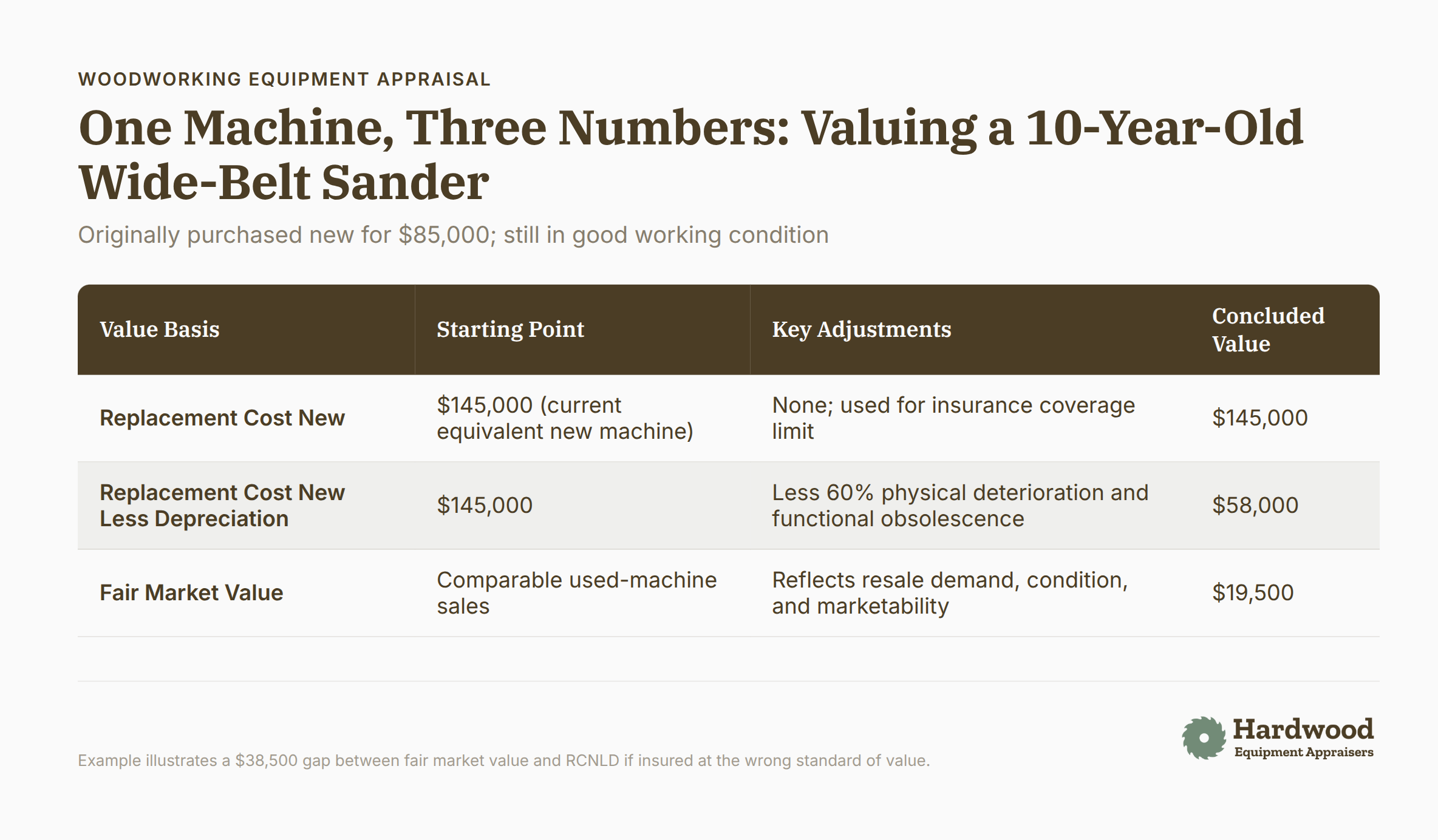
Assume a shop owns a 10-year-old wide-belt sander, originally purchased new for $85,000, still in regular production use and in good mechanical condition.
| Value Basis | Starting Point | Key Adjustments | Concluded Value |
|---|---|---|---|
| Replacement Cost New | $145,000 (current equivalent new machine) | None; used for insurance coverage limit | $145,000 |
| Replacement Cost New Less Depreciation | $145,000 | Less 60% physical deterioration and functional obsolescence | $58,000 |
| Fair Market Value | Comparable used-machine sales | Reflects actual resale demand, condition, and marketability | $19,500 |
Replacement cost new of $145,000 reflects what a comparable new wide-belt sander costs today, inflated well above the original $85,000 purchase price by a decade of price increases and improved control features. Replacement cost new less depreciation of $58,000 applies physical wear and functional obsolescence to that new-cost figure, producing the number an insurance policy is more likely to use for a claim settlement. Fair market value of $19,500 comes from actual sale prices of comparable used wide-belt sanders, which reflect a smaller pool of buyers, dealer margins, and the cost of rigging and transport that a buyer factors into their offer.
Example: If this shop insures the machine using the $19,500 fair market value figure instead of the $58,000 RCNLD figure, a total loss claim would leave a $38,500 gap between the payout and the actual cost to restore equivalent production capacity.
Key takeaway: The same machine, the same inspection, and the same appraiser can produce three defensible numbers. The one that matters is the one tied to the standard of value your situation actually requires.
Matching the Standard of Value to the Purpose of the Appraisal
The table below maps common appraisal purposes to the standard of value typically used, which is the single most important thing to confirm before ordering a report.
| Appraisal Purpose | Standard of Value Typically Used |
|---|---|
| Insurance coverage or claim | Replacement cost new, or replacement cost less depreciation |
| Tax, estate, or gift (IRS filings) | Fair market value |
| Resale or arm's-length sale | Fair market value |
| Divorce or equitable distribution | Fair market value |
| Financing or collateral | Fair market value or orderly liquidation value, depending on lender requirements |
A lender evaluating equipment as loan collateral, for example, often wants an orderly liquidation value rather than a straight fair market value, since it reflects what the equipment would bring if the lender needed to sell it within a defined timeframe. That is a different premise again from either replacement cost or standard fair market value, which is exactly why stating the report's intended use up front matters more than the dollar figure itself.
Choose the Standard That Matches Why You're Appraising
Before ordering a woodworking equipment appraisal, name the purpose first: insurance renewal, IRS filing, sale negotiation, divorce settlement, or loan collateral. That purpose determines whether the report should be built around replacement cost or fair market value, and a report built on the wrong standard can be rejected by the IRS, an insurer, or a court regardless of how carefully the machine was inspected. When you're ready to move forward, our team can scope your appraisal around the standard of value your situation actually requires.
This article is provided for general informational purposes only and does not constitute legal, tax, or financial advice. Readers should consult a qualified attorney or CPA regarding their specific circumstances.