
Blog
Estate Valuation of Woodworking Equipment: What the IRS Actually Expects
The IRS requires inherited woodworking equipment to be reported at fair market value on the date of death, not replacement cost, and estates above the federal exemption must attach a qualified appraisal to Form 706. This guide walks executors through the valuation standard, the 2025-2026 filing thresholds, and why a written appraisal matters even when no tax return is due.
When a woodworker dies leaving behind a shop full of machinery, the executor inherits a valuation problem most people never anticipate. A table saw, a jointer, a CNC router, and a dust collection system all have to be assigned a dollar value for the estate, and the IRS has clear expectations about how that value is calculated. Get it wrong, and you risk an inflated taxable estate, an inaccurate probate inventory, or a fight among heirs over who owes what.
Our team at our woodworking equipment appraisal service prepares USPAP-compliant valuations for exactly this situation: shop equipment that needs a defensible number for probate, estate tax, or family settlement. Here is what executors and heirs actually need to know.
Why Fair Market Value, Not Replacement Cost, Is the Standard
The IRS values estate property at fair market value as of the date of death, not what it would cost to buy the equivalent equipment new. The Form 706 instructions define fair market value as the price a willing buyer would pay a willing seller, with neither party under compulsion to act and both reasonably informed about the asset.
That distinction matters enormously for shop equipment. Replacement cost tells you what it costs to walk into a dealer and buy a new cabinet saw. Fair market value tells you what that same saw, eight years old with some wear on the table and a fence that needs realignment, would actually sell for between a private buyer and seller in the used-equipment market. For most shop tools, that gap is large, and it only grows as equipment ages.
Watch out: Executors sometimes default to insurance replacement values or the original purchase price because those numbers are easy to find. Neither is the correct standard for an estate filing, and using them can overstate the estate's value and create real tax exposure.
How the Willing Buyer, Willing Seller Test Applies to Shop Equipment
A long-standing IRS revenue ruling built the willing buyer, willing seller framework primarily for valuing closely held business interests, but appraisers extend the same logic to tangible personal property, including machinery and equipment. The ruling lists factors relevant to a defensible valuation opinion: the nature and history of the asset, its physical condition, the economic outlook for its use, and, most importantly, actual sales of comparable property in the relevant market.
For a woodshop, that means an appraiser looks at recent sales of similar table saws, jointers, and CNC routers of comparable age, condition, and capability, rather than a manufacturer's price list. Configuration matters too: a router with a vacuum table and a large working envelope is not comparable to a hobby-grade benchtop unit, even if both are called a "CNC router." Appraisers weigh age, brand, condition, tooling included, and whether the machine is operational, since a non-functioning unit sells for a fraction of a working one.
When Does Form 706 Come Into Play?
Form 706 is required only when the gross estate exceeds the federal filing threshold, and that threshold is scheduled to change between 2025 and 2026. For deaths in 2025, the federal estate tax exemption is $13.99 million for a single filer, roughly double that for a married couple using portability. For deaths in 2026, the IRS has confirmed the exemption rises to $15 million per individual, or $30 million for a married couple, reflecting adjustments under recent tax legislation.
Most estates, including most estates that include a home woodshop or a small cabinet and millwork business, fall well under these thresholds. That means the vast majority of executors handling inherited woodworking equipment will never file Form 706 at all. But falling under the threshold does not mean the valuation work disappears; it just changes who the number is for.
Key takeaway: The federal filing threshold determines whether the IRS ever sees a valuation of the equipment. It does not determine whether the equipment needs to be valued in the first place.
The $3,000 Threshold for Attaching an Appraiser's Statement
When an estate does file Form 706, the Schedule F instructions specifically list machinery, including farm and shop machinery, as property to report under "other miscellaneous property." The instructions require a written appraisal to be attached whenever a single item, or a group of similar items, is valued above a modest dollar threshold, commonly cited at $3,000, unless the executor can otherwise substantiate the value.
A home woodshop with a handful of mid-range tools might stay under that line item by item. A small commercial cabinet shop with a CNC router, an industrial dust collection system, and a bank of stationary machinery almost always crosses it, sometimes on a single piece of equipment. When it does, the report needs to identify the appraiser, describe the qualifying credentials, and state the methodology used to reach the conclusion, not just list a number.
The Alternate Valuation Date Option
Executors of larger estates also have the option to elect the alternate valuation date under IRC Section 2032, valuing the entire estate six months after death instead of on the date of death. This election applies to the whole estate, not selected assets, and it is generally used when asset values are expected to decline in the months after death. For most woodworking equipment, which depreciates steadily rather than swinging with the market, the six-month election rarely changes the outcome much, but it remains a planning option worth discussing with the estate's tax advisor.
Worked Example: Table Saw, Jointer, CNC Router, and Dust Collection
Consider a hobbyist-turned-part-time cabinetmaker who ran a small shop out of a detached garage for 12 years. At death, the shop held four significant pieces of equipment: a cabinet-grade table saw, an 8-inch jointer, a 3-axis CNC router used for cabinet door work, and a cyclone dust collection system with ductwork throughout the shop.
Example: If the executor pulled retail prices for new equivalents, the replacement cost total would run well over $31,000. But none of that equipment was new, and none of it would sell for anything close to that figure on the open market.
| Equipment | Replacement Cost (New) | Fair Market Value (Date of Death) |
|---|---|---|
| Cabinet table saw, 8 years old | $4,200 | $1,800 |
| 8-inch jointer, moderate wear | $2,600 | $950 |
| 3-axis CNC router, needs recalibration | $18,500 | $7,200 |
| Cyclone dust collection system | $6,000 | $2,100 |
| Total | $31,300 | $12,050 |
The fair market value total comes in at roughly 38% of replacement cost, a gap driven by age, wear, and the fact that used shop machinery simply does not command anywhere near new-equipment pricing in a private sale. Using the replacement figure on an estate inventory would overstate the taxable estate and, just as importantly, could set unrealistic expectations for heirs trying to divide or sell the equipment fairly.
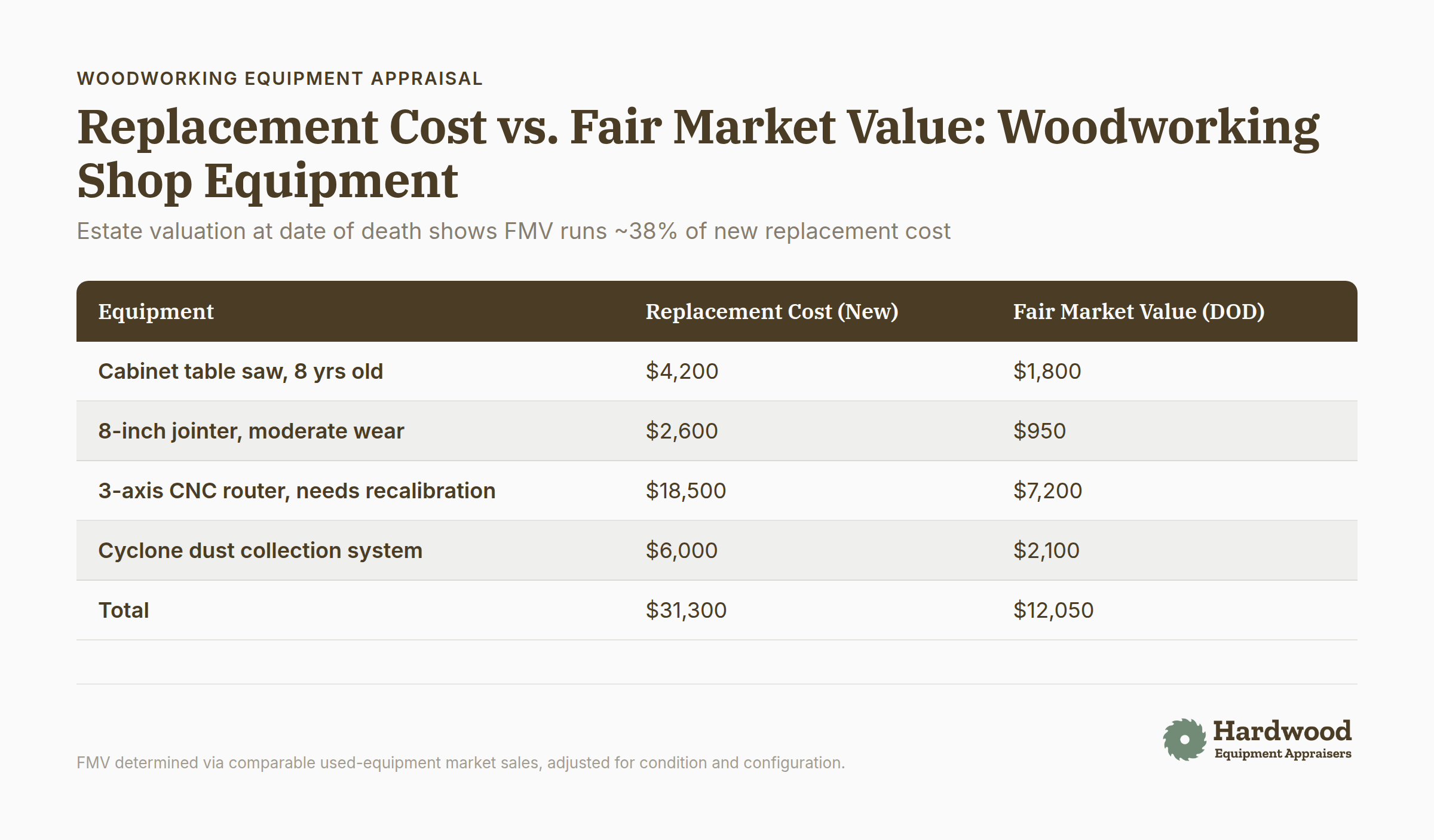
Appraisers reach FMV figures like these using comparable sales data from the used-equipment market, adjusted for the specific configuration, condition, and completeness of each machine, the same approach used for any other appraisal of used industrial or shop equipment.
Why Executors Below the Filing Threshold Still Need an Appraisal
Most estates with a home woodshop will never come near the federal exemption, which means Form 706 never gets filed and the IRS never asks for a number. That does not mean the equipment goes unvalued.
Probate courts in most states require an inventory of estate assets, and "shop tools, various" is not an acceptable line item when the equipment includes a $7,000 CNC router. Heirs dividing an estate need a defensible, unbiased number to split assets fairly, especially when one heir wants to keep the equipment and buy out the others' interest. And if the family decides to sell the shop's contents rather than keep them, a written appraisal establishes the baseline value a buyer or dealer should be measured against.
Pro tip: Get the appraisal done early in the probate process, even before a buyer or auction house is involved. A written report dated close to the date of death carries more weight with courts, co-heirs, and the IRS than a value assigned after the fact from memory or a dealer's quick verbal estimate.
What a USPAP-Compliant Appraisal Should Include
A credible estate appraisal of woodworking equipment should be prepared in accordance with USPAP (Uniform Standards of Professional Appraisal Practice) and should document more than just a final number:
- Make, model, and serial number for each significant piece of equipment
- Age, condition, and any modifications or missing accessories
- The valuation date used (date of death or the elected alternate date)
- The methodology applied, typically a market or sales comparison approach using comparable used-equipment transactions
- The intended use of the report (estate tax, probate inventory, or equitable distribution) and the appraiser's qualifying credentials
Our appraisers hold credentials with organizations such as the ASA and CAGA, and every report we prepare for estate purposes is built to stand up to review by a probate court, a co-executor, or the IRS. Fees for these engagements are quoted as a fixed price after we scope the assignment, based on the number of machines, the complexity of the shop, and whether the report needs to meet IRS-qualified standards; they are never billed by the hour.
Settling the Shop Fairly
An inherited woodshop is rarely just a financial line item. It is often the last tangible piece of a person's daily work, and getting the valuation right protects both the estate's tax position and the relationships among the people dividing it. Fair market value, grounded in real comparable sales rather than replacement cost or guesswork, is the standard the IRS expects and the standard that holds up when someone else has to sign off on the number.
This article is provided for general informational purposes only and does not constitute legal, tax, or financial advice. Readers should consult a qualified attorney or CPA regarding their specific circumstances.
If your family is settling an estate that includes a home shop or small woodworking business, request an appraisal to get a written, defensible valuation before probate moves forward.