
Blog
What Documentation Should You Gather Before a Woodshop Equipment Appraisal
The right documentation for an equipment appraisal, from serial numbers to maintenance logs, turns a woodshop valuation into a defensible, USPAP-compliant report. This checklist walks woodworking equipment owners through exactly what to gather before the appraiser arrives.
A woodshop appraisal is only as strong as the records behind it. Whether you're insuring a cabinet shop, settling an estate, splitting assets in a divorce, or selling a production line, the appraiser needs to connect every machine on the floor to a serial number, a purchase history, a condition record, and a value conclusion that will hold up to scrutiny. Owners who show up with a shoebox of receipts slow the process down and often end up with a thinner, less defensible report. This guide covers exactly what to pull together before our woodworking equipment appraisal team walks through your shop.
Why Documentation Matters for a Defensible Appraisal
Appraisal standards require the appraiser to identify the subject property and its relevant characteristics before forming an opinion of value. The Uniform Standards of Professional Appraisal Practice (USPAP).pdf?sfvrsn=5f6c1cde_1492) builds this identification requirement into the foundation of every appraisal assignment, and it applies whether the subject is a single CNC router or an entire production line.
Owner-supplied documentation does not replace the appraiser's own inspection. An appraiser still has to walk the floor, verify nameplates, and judge condition in person. But good records narrow the gap between what you know about your equipment and what the appraiser can independently confirm. They also shorten the site visit, reduce the chance of a machine being mis-identified or omitted, and give the appraiser a paper trail to cite in the workfile if the report is ever challenged by an insurer, a court, or the IRS.
Key takeaway: documentation doesn't determine the value on its own. It supports the appraiser's identification of the asset, which is the first step every credible valuation has to get right.
Serial Numbers and Nameplate Data
Every major machine in a woodshop carries a manufacturer's nameplate, and that plate is the single most important piece of identification data you can hand an appraiser. For table saws, jointers, planers, edge-banders, and CNC routers, the nameplate typically lists the manufacturer, model number, serial number, year of manufacture, voltage, and horsepower.
Before the appraisal, walk your shop and record this information for each piece:
- Table saws and jointers: manufacturer, model, serial number, blade or cutter-head size, and any aftermarket fence or guard upgrades
- Planers: manufacturer, model, serial number, maximum width and depth of cut, and knife or cutter-head type
- CNC routers: manufacturer, model, serial number, table size, spindle specifications, and control software version
- Dust collection systems: manufacturer, model, serial number, cubic-feet-per-minute rating, and ductwork configuration
- Compressors, edge-banders, and finishing equipment: manufacturer, model, serial number, and tank or capacity rating
Nameplates fade, get painted over, or sit in hard-to-reach spots on older machines. If a plate is illegible, note it and photograph it anyway; a partial serial number is still more useful to the appraiser than none at all.
Purchase Records and Acquisition Cost
Original invoices, bills of sale, dealer quotations, and financing documents establish when you bought each machine, what you paid, and whether any freight, rigging, or installation costs were rolled into the purchase. This matters for several reasons: acquisition cost anchors a cost-approach analysis, the purchase date helps the appraiser estimate age-related depreciation, and financing or lien documents flag anything that isn't fully owned.
Gather, for each major machine:
- The original invoice, bill of sale, or dealer quote
- Freight, rigging, and installation costs if they were billed separately
- Any loan, lease, or UCC filing tied to the equipment
- Payoff statements or lien releases if the equipment has since been paid off
If you no longer have the original paperwork, don't skip this step entirely. Bank statements, cancelled checks, or even email confirmations from a dealer can help the appraiser reconstruct acquisition history, and our guide on how to calculate the value of used equipment walks through how age and cost factor into the final number.
Maintenance and Service Logs
A planer that's had its knives replaced every season and its bearings serviced on schedule is worth more than an identical model that's been run into the ground. Maintenance records are one of the clearest ways to demonstrate actual condition rather than relying on a visual impression during a single site visit.
Keep a log, even an informal one, that tracks:
- Blade, knife, and cutter-head replacements
- Motor repairs or rebuilds
- Calibration records, especially for CNC equipment
- Hydraulic, electrical, or control-system repairs
- Any retrofits, upgrades, or replaced components
Pro tip: if you've never kept formal logs, start reconstructing one from repair invoices, parts receipts, and even text messages to a service technician. An appraiser can work with an incomplete log, but a complete one lets them weigh condition with real confidence instead of guesswork.
Photographs That Support the Inspection
Photographs don't replace a physical inspection, but they give the appraiser a second reference point and help reconcile your equipment list with what's actually on the floor. For each machine, capture:
- An overall shot of the entire unit, including its footprint and surrounding workspace
- A close-up of the nameplate or serial tag, even if it's partially worn
- Any visible condition issues: rust, cracked housings, missing guards, or worn surfaces
- Attached tooling, jigs, or accessory packages that came with the machine
- Wide shots of the shop layout, showing dust collection ductwork, electrical runs, and material flow
Watch out: don't photograph machines in isolation without any identifying detail. A photo that shows only the cutting surface of a table saw, with no nameplate and no serial number visible, does little to help the appraiser confirm what they're looking at.
Organizing Your Inventory by Machine Type
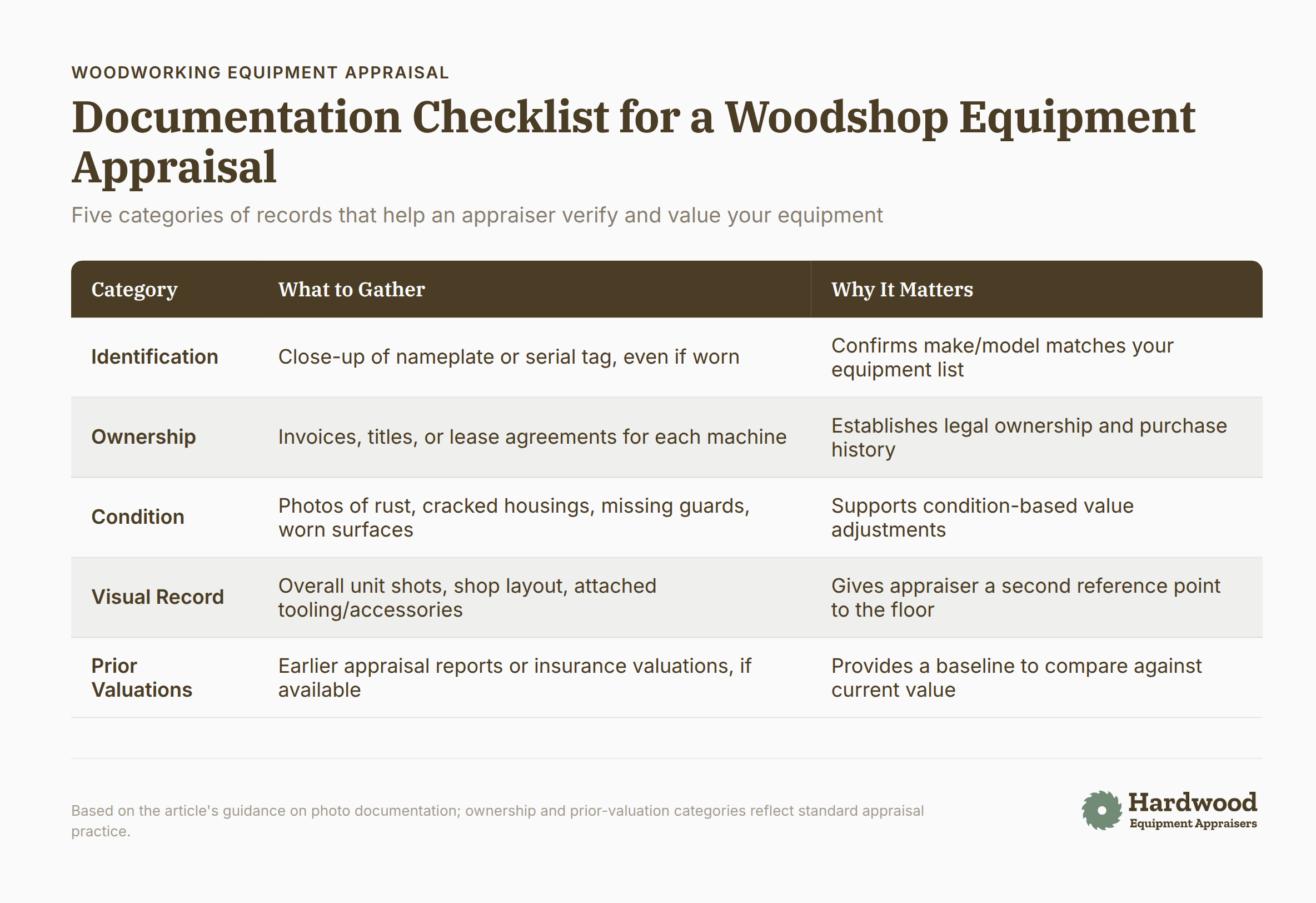
Once you've gathered serial numbers, purchase records, maintenance logs, and photographs, organize everything into a single inventory list grouped by machine type. This is the document the appraiser will use to cross-reference the shop floor against your paperwork, so it needs to be complete and consistent.
| Category | What to Gather | Why It Matters |
|---|---|---|
| Identification | Make, model, serial number, nameplate photo | Confirms exactly what machine is being valued |
| Ownership | Invoice, bill of sale, loan or lease documents, lien releases | Establishes acquisition cost and any encumbrances |
| Condition | Maintenance logs, repair invoices, calibration records | Supports the appraiser's condition rating beyond a visual impression |
| Visual record | Overall photos, nameplate close-ups, defect photos | Backs up the written description in the report |
| Prior valuations | Old appraisals, insurance schedules, depreciation records | Provides a baseline for comparison and continuity between reports |
A woodshop with a dozen major machines might organize this as a simple spreadsheet, one row per machine, with columns matching the table above. Larger shops with CNC lines, multiple dust collection zones, and finishing departments benefit from grouping by department or production stage.
Prior Appraisals and Insurance Schedules
If your shop has been appraised before, for insurance, a prior sale, or an earlier estate matter, bring that report along even if it's several years old. A previous appraisal gives the current appraiser a documented baseline: what machines existed, what they were worth at that time, and what methodology was used. It also helps flag any equipment that's since been sold, scrapped, or replaced.
Existing insurance schedules serve a similar purpose. If your policy lists scheduled values for individual machines, those figures (and the basis for them) are useful background, even though the appraiser will independently determine current fair market value or replacement cost rather than simply updating the old numbers.
If the Appraisal Is for a Charitable Donation
Donating woodworking equipment to a trade school, nonprofit workshop, or community program carries its own documentation requirements. The IRS requires Form 8283 for any noncash deduction over $500, including a group of similar items, and a qualified appraisal is generally required once the claimed deduction for an item or group exceeds $5,000. For deductions over $500,000, the qualified appraisal generally must be attached to the return, subject to applicable exceptions, as described in the IRS Form 8283 instructions. The IRS guidance on substantiating noncash contributions outlines the donor and donee information that should accompany the appraisal.
For a donation appraisal, add these to your documentation package:
- Donor and donee information, including the receiving organization's details
- Date and method of original acquisition
- Cost or other basis, when available
- Date of the contribution itself
Our woodworking equipment appraisal for charitable donation service is built around these exact IRS requirements, so the report arrives ready to attach to Form 8283.
The Documentation Checklist
Use this list to prepare for the site visit itself:
- Walk the shop and list every machine, including dust collection, compressors, and finishing equipment, not just the headline table saws and planers.
- Record nameplate data for each machine, copying manufacturer, model, serial number, and year even when plates are partially worn.
- Pull purchase records, including invoices, bills of sale, financing documents, and any lien releases.
- Assemble maintenance and service logs, reconstructing them from repair invoices if formal logs don't exist.
- Photograph every machine, capturing the overall unit, the nameplate, and any visible condition issues.
- Build a single inventory spreadsheet, organized by machine type, with a row for each asset and columns matching your supporting records.
- Gather prior appraisals and insurance schedules, even outdated ones, as a baseline for comparison.
- Confirm the intended use of the appraisal (insurance, estate, sale, divorce, or donation) so the appraiser applies the correct definition of value from day one.
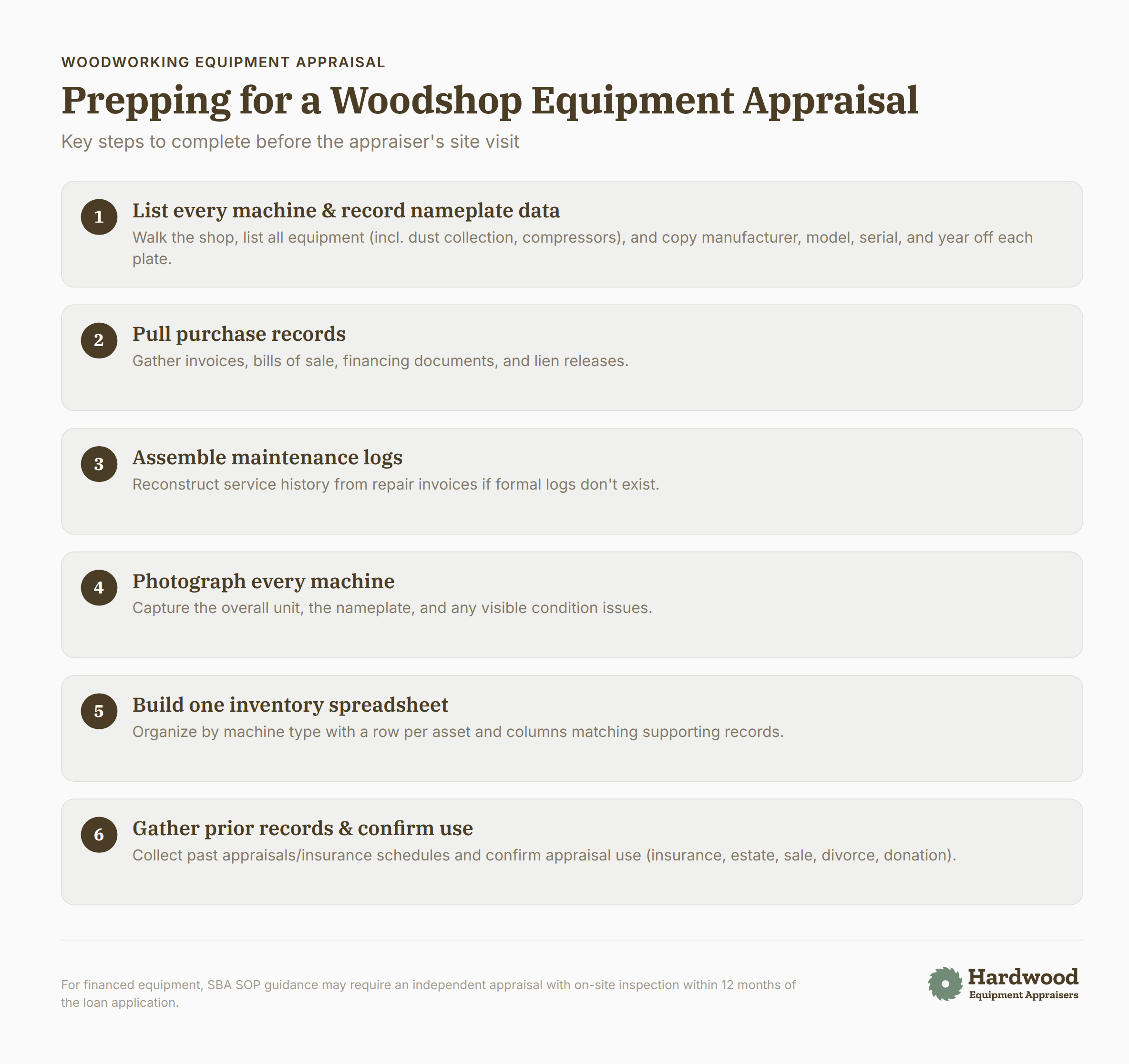
For financed equipment, SBA-related lending rules can require a written appraisal from a qualified, independent appraiser with an on-site inspection dated within 12 months of the loan application when used equipment is purchased from someone other than a dealer or is being refinanced, as summarized in publicly available SBA SOP guidance. If your appraisal is supporting a loan application, confirm with your lender which documentation they expect to see attached to the report.
Bringing It All Together
A complete documentation package doesn't replace the appraiser's inspection, but it does the opposite of slowing things down: it lets the appraiser spend the site visit confirming what you've already documented rather than reconstructing it from scratch. Our appraisers hold credentials with organizations such as the ASA, ISA, and NEBB, and every woodshop report we prepare is built to the identification and reporting standards those organizations recognize. The better your paperwork, the faster and more defensible that report will be.
If you're preparing for an upcoming valuation, start with the checklist above and request an appraisal once your documentation is in order. Our team will tell you exactly what's still missing before the site visit, not after.
This article is provided for general informational purposes only and does not constitute legal, tax, or financial advice. Readers should consult a qualified attorney or CPA regarding their specific circumstances.